
Back to Home
Circle.
Product Design.
UPI/Fintech.
AI Intelligence.
A UPI payment experience designed around the relationship behind every transaction.

Research & Behaviour
Investigated the social friction around lending and repayment through primary research, interviews, and behavioural analysis, turning patterns of avoidance into product requirements.
Product Strategy
Translated the research into Circle's product model, defining the relationship layer, Kin's role, MVP boundaries, and how the product could intervene without making money feel transactional.
UX & Interaction
Designed the end-to-end experience across familiar UPI payments, Circle relationships, repayment intent, shared expectations, Kin interventions, and ambiguity resolution.
Visual Language
Built Circle's visual identity and product language across brand, UI, typography, colour, components, motion, and physical touchpoints.
Quick Navigation.
Overview.
Money between friends is never really about money.
Circle is a UPI-based payments platform built around a question most fintech products ignore: “what happens after the payment?” It combines familiar payments with a private relationship layer, and Kin, an intelligence system that understands the context around money between people without turning it into a ledger.
This started with ₹2,000 I never asked a friend to return.
The Problem.
The debt isn't the problem. The conversation is.
I lent a friend ₹2,000. Nothing dramatic. The kind of amount that shouldn't matter between two people who've known each other for years.
Three months later, I still hadn't asked for it back. Not because I'd forgotten. I just couldn't find a way to bring it up without making it feel like an accusation.
Then I started asking people around me about it. The stories were surprisingly similar. Friends who were owed money but had stopped asking. People who would rather quietly write off a few thousand rupees than make a friendship feel transactional.
The apps already knew the numbers. GPay knew I sent ₹2,000. Splitwise could tell me who owed what. A reminder could tell someone to pay.
But none of them understood whether I should ask at all.
That became the design question. The problem wasn't tracking debt. It was knowing when to act, when to wait, and when to leave the relationship alone.
Research.
I didn't want to design around one awkward ₹2,000.
So I ran a short study to understand how people really feel about lending and borrowing money with close friends.
28
Respondents
26 had direct experience
lending or borrowing
Survey
Age: 21 – 36
Location: India + USA
What we found.
92.9%
Have lent or borrowed money from someone close.
84.6%
Have avoided asking someone close for repayment.
52%
Worried that asking would make the other person feel guilty or embarrassed.
~45%
Said the money was eventually repaid without being asked.
What people said.
"I don't feel free to ask him. He's my best friend."
– 24, Male
"I keep waiting for the right time."
– 27, Female
"Sometimes I just let it go. It's easier."
– 23, Male
Patterns.
Protect the relationship
People avoid asking to prevent awkwardness,
guilt or strain.
Natural repayment happens
Almost half said the money came back without
reminders.
Uncertainty creates stress
Not knowing when (or if) they'll get repaid causes
constant mental load.
No shared context
Both sides often have different expectations
about repayment.
The problem isn't tracking debt. It's knowing when to act, when to wait, and when to leave the relationship alone.
Approach.
Finding the right intervention through research.
The research showed that repayment isn't always the problem. Sometimes the money comes back naturally. Sometimes asking creates unnecessary friction. The approach became less about prompting repayment and more about understanding when intervention actually helps.
Phase 01
Understand the behavior
Map the moments around lending, borrowing, waiting, repayment, and avoidance. The goal was to understand where the financial transaction ends and the relationship friction begins.
Phase 02
Translate findings into principles
Turn research patterns into product requirements: don't assume every unpaid transaction needs action, don't make users initiate difficult conversations, and don't make money feel like accounting.
Phase 03
Define Kin's role
Explore where intelligence could reduce uncertainty without becoming intrusive. Kin should know when to act, when to wait, and when to stay quiet.
Phase 04
Design within familiar UPI
Keep the payment experience familiar and introduce Circle only where relationship context adds value. The goal was not to redesign UPI, but to add the missing layer around it.
Product Strategy.
From repayment tracking to relationship management.
The research changed the problem we were solving. Circle wasn't meant to help people keep a better debt ledger. It needed to understand the relationship around the transaction and reduce the social friction that comes after it.
Pay
Standard UPI payments. Keep the interaction familiar. Sending, receiving, scanning, and requesting money should work the way users already understand.
The relationship layer. A private space that remembers the context around money between people without turning the relationship into a financial ledger.
The private relationship layer.
Kin
The intelligence layer. Kin understands the context around transactions and helps determine when to intervene, when to wait, and when to stay quiet.
Don't build a debt tracker.
Build a relationship layer around payments.
Strategy Constraints
Keep UPI familiar.
Circle should not force users to learn a new payment behavior just to get relationship
context.
Context before intervention
Kin should only intervene when there is enough context to make the intervention useful.
Silence is a valid outcome
Not every unpaid transaction requires a reminder. Sometimes the right product decision is to do nothing.
The Decisions.
Decision 01
Intent before intervention.
Circle asks one question the moment money moves: will you need this back? Capturing that intent while it's still fresh gives Kin context without turning the payment itself into a debt-management flow.
Trade-Off
One lightweight interaction on an otherwise familiar UPI flow, in exchange for context Kin would otherwise have to guess at later.

Decision 02
Kin waits for context, not just time.
An unpaid transaction isn't automatically a problem. Kin starts with a casual check-in: “Have you had a chance to repay Rahul?” sitting quietly alongside the payment itself, not as an interruption. If that goes nowhere, Kin escalates gradually: first confirming whether an earlier payment was actually settled, then, only if it wasn't, asking directly when the sender can expect it. Each step only happens if the last one didn't resolve anything.
Trade-Off
Escalating gradually takes longer than asking for a date upfront, but it means Kin only gets specific once quieter signals have already failed.

Decision 03
Kin doesn't become another inbox.
Kin isn't a destination.
There's no “open Kin, check balances, manage reminders” screen. It stays in the background and surfaces only when something is actually worth resolving.
Trade-Off
Less at-a-glance visibility into what Kin is tracking, in exchange for one less dashboard to maintain.

Decision 04
Mediate, don't decide.
If a sender expects repayment by Friday and the receiver's own sense of it is closer to "sometime," Kin doesn't expose that gap or decide who's right. It checks in with each person separately, then steps back if nothing is resolved after two check-ins.
Trade-Off
Private mediation protects the relationship, but makes Kin's reasoning harder to see from the outside.

Interface.
Designing the relationship layer around familiar UPI.
Circle keeps the familiar mechanics of UPI while introducing a new layer of relationship context. The interface had to make that layer feel present without making it feel like another financial tool.
01 / The Core Experience

02 / Circle
The relationship layer.
A private space that keeps the context around money between people.

03 / Pay
The familiar payment layer.
Standard UPI interactions stay simple, predictable, and unchanged.

04/ Intelligence layer
The Intelligence layer.
Kin observes context, intervenes selectively, and knows when to step back.

Style Guide.
Bold shell. Quiet intelligence.
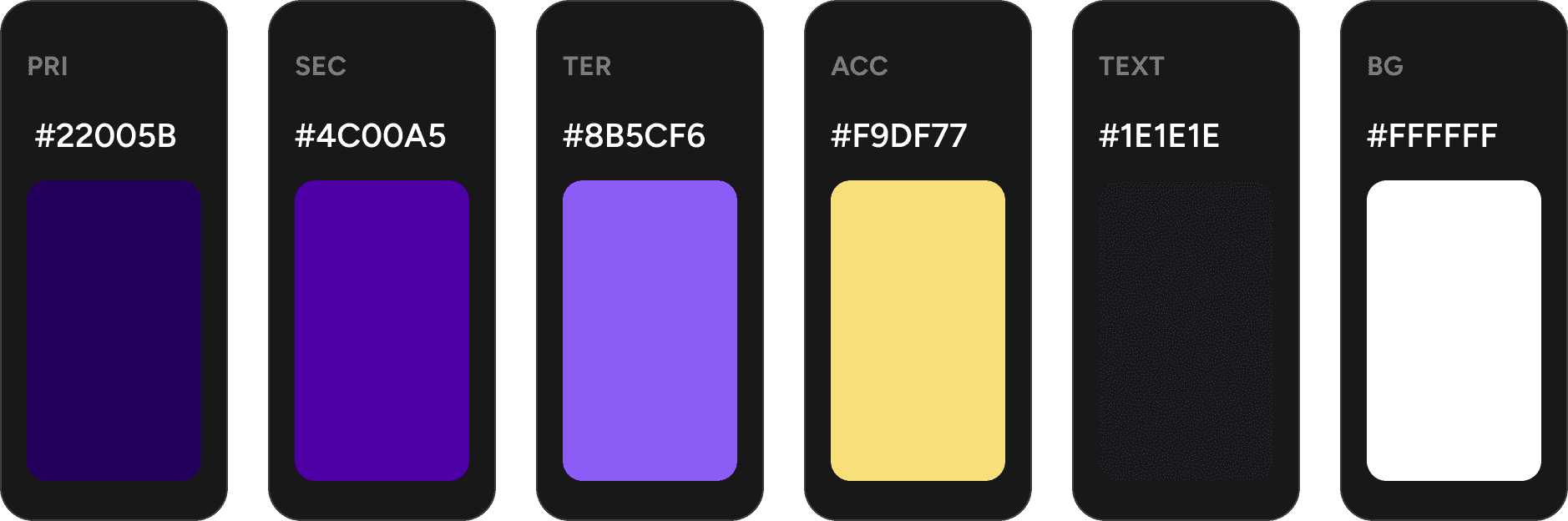
Circle uses a strong, utilitarian visual shell for the product and a quieter visual language for Kin. The system keeps payments familiar while giving relationship context its own semantic space.
Pri
#22005B
Sec
#4C00A5
Ter
#8B5CF6
Acc
#F9DF77
Text
#1E1E1E
BG
#FFFFFF
Name
Font size
Font Weight
Display
32 px
Bold
Heading 1
24 px
Semi Bold
Heading 2
18 px
Semi Bold
Paragraph 1
16 px
Regular
Paragraph 2
14 px
Regular
Tag / Body
12 px
Medium
Button
20 px
Medium
A
a
Heading
Epilogue
Google sans

Brand Application.
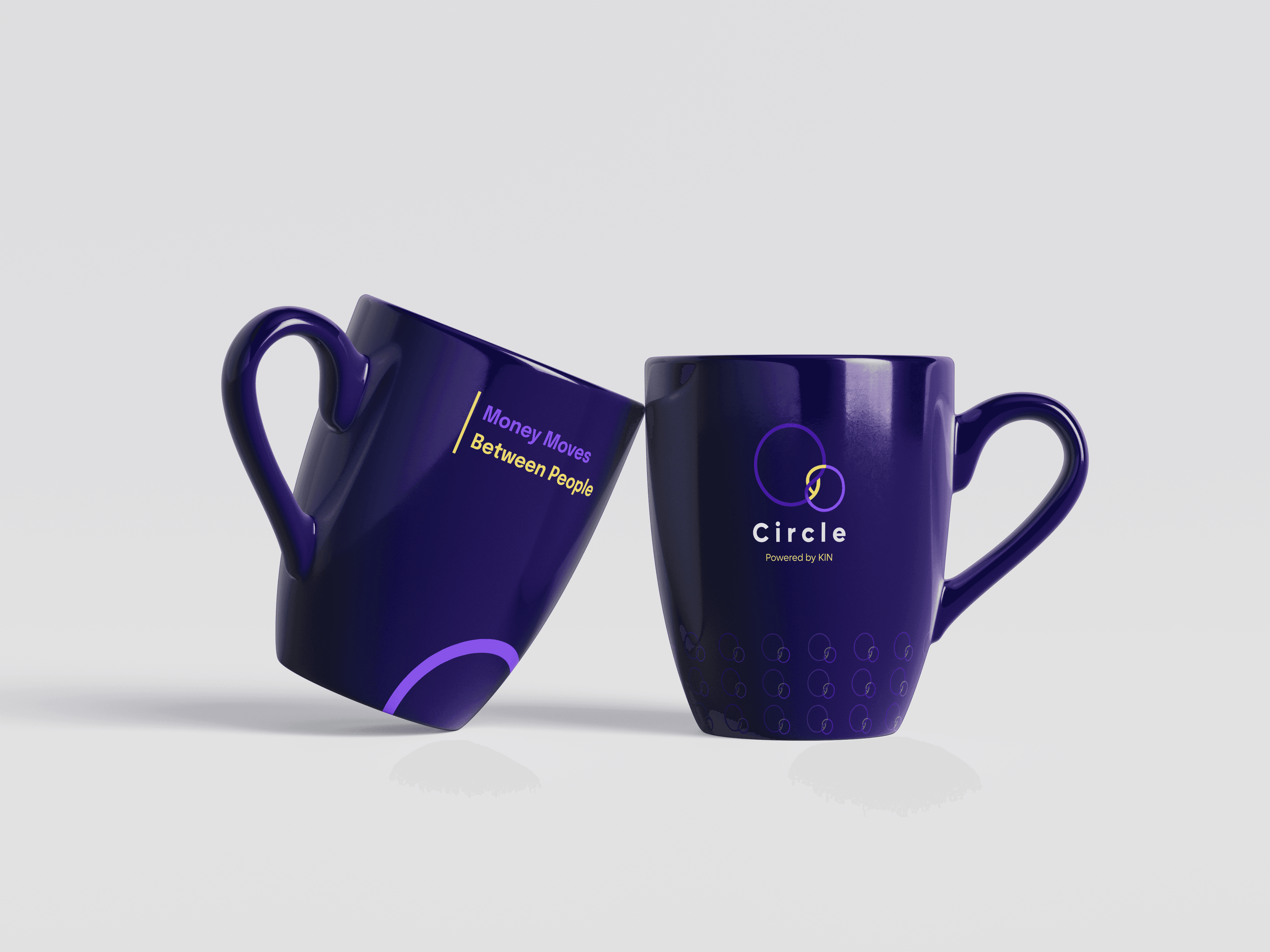
A visual system built to move beyond the interface.
Circle's identity extends across physical touchpoints through its mark, colour, typography, and recurring relationship motif.




Learnings.
Context is more valuable than automation.
The easiest product decision would have been to remind people when money remained unpaid. Research showed why that was wrong. Kin became useful only when it could understand the context around a transaction and decide whether intervention was warranted.
Not every problem needs a notification.
Some money comes back naturally. Some situations need a conversation. Some are better left alone. Designing Kin meant treating silence as a legitimate product outcome, not a failure state.
Familiarity is a feature.
Circle didn't need to reinvent UPI to add relationship context. Keeping Pay familiar meant the intelligence could appear around the transaction without making the core payment experience harder to understand.
An AI assistant shouldn't need managing.
Kin works best when users don't have to think about Kin. There is no dashboard to maintain or queue of debts to clear. It observes, intervenes when useful, and steps back when it isn't.
The best intervention is sometimes knowing when not to intervene.
Conclusion.
The payment ends. The relationship continues.
Circle started with a simple problem: people can send money instantly, but knowing what happens after the payment is much harder. The final experience doesn't try to turn friendship into accounting. It captures intent early, gives Kin enough context to act thoughtfully, and keeps intervention quiet when the situation doesn't need it.
I didn't design Circle to make people better at collecting money. I designed it to make the awkward part around money easier to navigate.
Money moves between people.
Circle understands what happens in between.
Back to Home
Circle.
Product Design.
UPI/Fintech.
AI Intelligence.
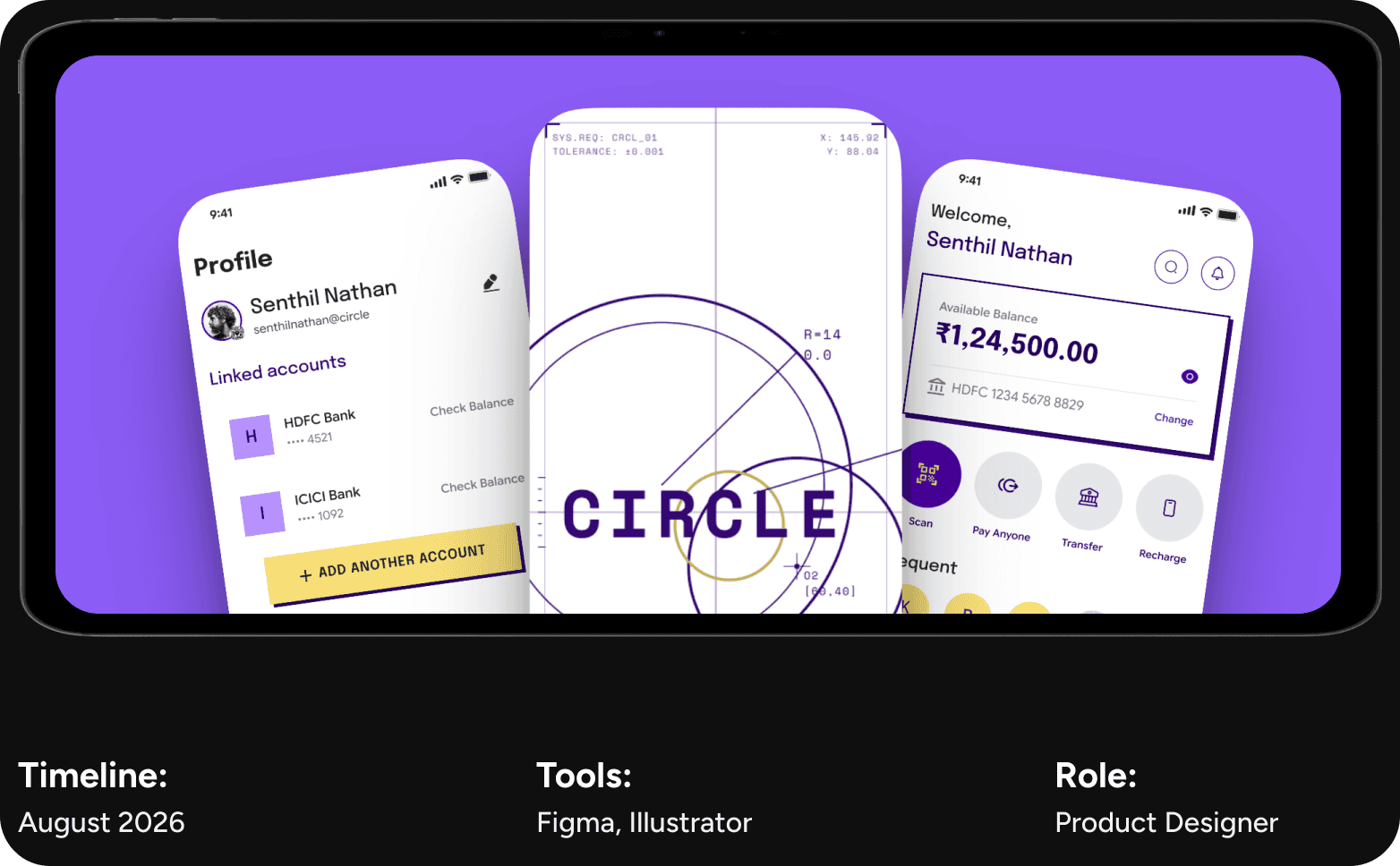
A UPI payment experience designed around the relationship behind every transaction.
Research & Behaviour
Investigated the social friction around lending and repayment through primary research, interviews, and behavioural analysis, turning patterns of avoidance into product requirements.
Product Strategy
Translated the research into Circle's product model, defining the relationship layer, Kin's role, MVP boundaries, and how the product could intervene without making money feel transactional.
UX & Interaction
Designed the end-to-end experience across familiar UPI payments, Circle relationships, repayment intent, shared expectations, Kin interventions, and ambiguity resolution.
Visual Language
Built Circle's visual identity and product language across brand, UI, typography, colour, components, motion, and physical touchpoints.
Quick Navigation.
Overview.
Money between friends is never really about money.
Circle is a UPI-based payments platform built around a question most fintech products ignore: “what happens after the payment?” It combines familiar payments with a private relationship layer, and Kin, an intelligence system that understands the context around money between people without turning it into a ledger.
This started with ₹2,000 I never asked a friend to return.
The Problem.
The debt isn't the problem. The conversation is.
I lent a friend ₹2,000. Nothing dramatic. The kind of amount that shouldn't matter between two people who've known each other for years.
Three months later, I still hadn't asked for it back. Not because I'd forgotten. I just couldn't find a way to bring it up without making it feel like an accusation.
Then I started asking people around me about it. The stories were surprisingly similar. Friends who were owed money but had stopped asking. People who would rather quietly write off a few thousand rupees than make a friendship feel transactional.
The apps already knew the numbers. GPay knew I sent ₹2,000. Splitwise could tell me who owed what. A reminder could tell someone to pay.
But none of them understood whether I should ask at all.
That became the design question. The problem wasn't tracking debt. It was knowing when to act, when to wait, and when to leave the relationship alone.
Research.
I didn't want to design around one awkward ₹2,000.
So I ran a short study to understand how people really feel about lending and borrowing money with close friends.
28
Respondents
26 had direct experience
lending or borrowing
Survey
Age: 21 – 36
Location: India + USA
What we found.
92.9%
Have lent or borrowed money from someone close.
84.6%
Have avoided asking someone close for repayment.
52%
Worried that asking would make the other person feel guilty or embarrassed.
~45%
Said the money was eventually repaid without being asked.
What people said.
"I don't feel free to ask him. He's my best friend."
– 24, Male
"I keep waiting for the right time."
– 27, Female
"Sometimes I just let it go. It's easier."
– 23, Male
Patterns.
Protect the relationship
People avoid asking to prevent awkwardness, guilt or strain.
Natural repayment happens
Almost half said the money came back without reminders.
Uncertainty creates stress
Not knowing when (or if) they'll get repaid causes constant mental load.
No shared context
Both sides often have different expectations about repayment.
The problem isn't tracking debt. It's knowing when to act, when to wait, and when to leave the relationship alone.
Approach.
Finding the right intervention through research.
The research showed that repayment isn't always the problem. Sometimes the money comes back naturally. Sometimes asking creates unnecessary friction. The approach became less about prompting repayment and more about understanding when intervention actually helps.
Phase 01
Understand the behavior
Map the moments around lending, borrowing, waiting, repayment, and avoidance. The goal was to understand where the financial transaction ends and the relationship friction begins.
Phase 02
Translate findings into principles
Turn research patterns into product requirements: don't assume every unpaid transaction needs action, don't make users initiate difficult conversations, and don't make money feel like accounting.
Phase 03
Define Kin's role
Explore where intelligence could reduce uncertainty without becoming intrusive. Kin should know when to act, when to wait, and when to stay quiet.
Phase 04
Design within familiar UPI
Keep the payment experience familiar and introduce Circle only where relationship context adds value. The goal was not to redesign UPI, but to add the missing layer around it.
Product Strategy.
From repayment tracking to relationship management.
The research changed the problem we were solving. Circle wasn't meant to help people keep a better debt ledger. It needed to understand the relationship around the transaction and reduce the social friction that comes after it.
Pay
Standard UPI payments. Keep the interaction familiar. Sending, receiving, scanning, and requesting money should work the way users already understand.
The relationship layer. A private space that remembers the context around money between people without turning the relationship into a financial ledger.
The private relationship layer.
Kin
The intelligence layer. Kin understands the context around transactions and helps determine when to intervene, when to wait, and when to stay quiet.
Don't build a debt tracker.
Build a relationship layer around payments.
Strategy Constraints
Keep UPI familiar.
Circle should not force users to learn a new payment behavior just to get relationship
context.
Context before intervention
Kin should only intervene when there is enough context to make the intervention useful.
Silence is a valid outcome
Not every unpaid transaction requires a reminder. Sometimes the right product decision is to do nothing.
The Decisions.
Decision 01
Intent before intervention.
Circle asks one question the moment money moves: will you need this back? Capturing that intent while it's still fresh gives Kin context without turning the payment itself into a debt-management flow.
Trade-Off
One lightweight interaction on an otherwise familiar UPI flow, in exchange for context Kin would otherwise have to guess at later.
Decision 02
Kin waits for context, not just time.
An unpaid transaction isn't automatically a problem. Kin starts with a casual check-in: “Have you had a chance to repay Rahul?” sitting quietly alongside the payment itself, not as an interruption. If that goes nowhere, Kin escalates gradually: first confirming whether an earlier payment was actually settled, then, only if it wasn't, asking directly when the sender can expect it. Each step only happens if the last one didn't resolve anything.
Trade-Off
Escalating gradually takes longer than asking for a date upfront, but it means Kin only gets specific once quieter signals have already failed.
Decision 03
Kin doesn't become another inbox.
Kin isn't a destination.
There's no “open Kin, check balances, manage reminders” screen. It stays in the background and surfaces only when something is actually worth resolving.
Trade-Off
Less at-a-glance visibility into what Kin is tracking, in exchange for one less dashboard to maintain.
Decision 04
Mediate, don't decide.
If a sender expects repayment by Friday and the receiver's own sense of it is closer to "sometime," Kin doesn't expose that gap or decide who's right. It checks in with each person separately, then steps back if nothing is resolved after two check-ins.
Trade-Off
Private mediation protects the relationship, but makes Kin's reasoning harder to see from the outside.
Interface.
Designing the relationship layer around familiar UPI.
Circle keeps the familiar mechanics of UPI while introducing a new layer of relationship context. The interface had to make that layer feel present without making it feel like another financial tool.
01 / The Core Experience
02 / Circle
The relationship layer.
A private space that keeps the context around money between people.
03 / Pay
The familiar payment layer.
Standard UPI interactions stay simple, predictable, and unchanged.
04/ Intelligence layer
The Intelligence layer.
Kin observes context, intervenes selectively, and knows when to step back.

Style Guide.
Bold shell. Quiet intelligence.
Circle uses a strong, utilitarian visual shell for the product and a quieter visual language for Kin. The system keeps payments familiar while giving relationship context its own semantic space.
Pri
#22005B
Sec
#4C00A5
Ter
#8B5CF6
Acc
#F9DF77
Text
#1E1E1E
BG
#FFFFFF
Name
Font size
Font Weight
Display
32 px
Bold
Heading 1
24 px
Semi Bold
Heading 2
18 px
Semi Bold
Paragraph 1
16 px
Regular
Paragraph 2
14 px
Regular
Tag / Body
12 px
Medium
Button
20 px
Medium
A
a
Heading
Epilogue
Google sans
Brand Application.
A visual system built to move beyond the interface.
Circle's identity extends across physical touchpoints through its mark, colour, typography, and recurring relationship motif.
Learnings.
Context is more valuable than automation.
The easiest product decision would have been to remind people when money remained unpaid. Research showed why that was wrong. Kin became useful only when it could understand the context around a transaction and decide whether intervention was warranted.
Not every problem needs a notification.
Some money comes back naturally. Some situations need a conversation. Some are better left alone. Designing Kin meant treating silence as a legitimate product outcome, not a failure state.
Familiarity is a feature.
Circle didn't need to reinvent UPI to add relationship context. Keeping Pay familiar meant the intelligence could appear around the transaction without making the core payment experience harder to understand.
An AI assistant shouldn't need managing.
Kin works best when users don't have to think about Kin. There is no dashboard to maintain or queue of debts to clear. It observes, intervenes when useful, and steps back when it isn't.
The best intervention is sometimes knowing when not to intervene.
Conclusion.
The payment ends. The relationship continues.
Circle started with a simple problem: people can send money instantly, but knowing what happens after the payment is much harder. The final experience doesn't try to turn friendship into accounting. It captures intent early, gives Kin enough context to act thoughtfully, and keeps intervention quiet when the situation doesn't need it.
I didn't design Circle to make people better at collecting money. I designed it to make the awkward part around money easier to navigate.
Money moves between people.
Circle understands what happens in between.
Back to Home
Circle.
Product Design.
UPI/Fintech.
AI Intelligence.
A UPI payment experience designed around the relationship behind every transaction.
Research & Behaviour
Investigated the social friction around lending and repayment through primary research, interviews, and behavioural analysis, turning patterns of avoidance into product requirements.
Product Strategy
Translated the research into Circle's product model, defining the relationship layer, Kin's role, MVP boundaries, and how the product could intervene without making money feel transactional.
UX & Interaction
Designed the end-to-end experience across familiar UPI payments, Circle relationships, repayment intent, shared expectations, Kin interventions, and ambiguity resolution.
Visual Language
Built Circle's visual identity and product language across brand, UI, typography, colour, components, motion, and physical touchpoints.
Quick Navigation.
Overview.
Money between friends is never really about money.
Circle is a UPI-based payments platform built around a question most fintech products ignore: “what happens after the payment?” It combines familiar payments with a private relationship layer, and Kin, an intelligence system that understands the context around money between people without turning it into a ledger.
This started with ₹2,000 I never asked a friend to return.
The Problem.
The debt isn't the problem. The conversation is.
I lent a friend ₹2,000. Nothing dramatic. The kind of amount that shouldn't matter between two people who've known each other for years.
Three months later, I still hadn't asked for it back. Not because I'd forgotten. I just couldn't find a way to bring it up without making it feel like an accusation.
Then I started asking people around me about it. The stories were surprisingly similar. Friends who were owed money but had stopped asking. People who would rather quietly write off a few thousand rupees than make a friendship feel transactional.
The apps already knew the numbers. GPay knew I sent ₹2,000. Splitwise could tell me who owed what. A reminder could tell someone to pay.
But none of them understood whether I should ask at all.
That became the design question. The problem wasn't tracking debt. It was knowing when to act, when to wait, and when to leave the relationship alone.
Research.
I didn't want to design around one awkward ₹2,000.
So I ran a short study to understand how people really feel about lending and borrowing money with close friends.
28
Respondents
26 had direct experience
lending or borrowing
Survey
Age: 21 – 36
Location: India + USA
What we found.
92.9%
Have lent or borrowed money from someone close.
84.6%
Have avoided asking someone close for repayment.
52%
Worried that asking would make the other person feel guilty or embarrassed.
~45%
Said the money was eventually repaid without being asked.
What people said.
"I don't feel free to ask him. He's my best friend."
– 24, Male
"I keep waiting for the right time."
– 27, Female
"Sometimes I just let it go. It's easier."
– 23, Male
Patterns.
Protect the relationship
People avoid asking to prevent awkwardness, guilt or strain.
Natural repayment happens
Almost half said the money came back without reminders.
Uncertainty creates stress
Not knowing when (or if) they'll get repaid causes constant mental load.
No shared context
Both sides often have different expectations about repayment.
The problem isn't tracking debt. It's knowing when to act, when to wait, and when to leave the relationship alone.
Approach.
Finding the right intervention through research.
The research showed that repayment isn't always the problem. Sometimes the money comes back naturally. Sometimes asking creates unnecessary friction. The approach became less about prompting repayment and more about understanding when intervention actually helps.
Phase 01
Understand the behavior
Map the moments around lending, borrowing, waiting, repayment, and avoidance. The goal was to understand where the financial transaction ends and the relationship friction begins.
Phase 02
Translate findings into principles
Turn research patterns into product requirements: don't assume every unpaid transaction needs action, don't make users initiate difficult conversations, and don't make money feel like accounting.
Phase 03
Define Kin's role
Explore where intelligence could reduce uncertainty without becoming intrusive. Kin should know when to act, when to wait, and when to stay quiet.
Phase 04
Design within familiar UPI
Keep the payment experience familiar and introduce Circle only where relationship context adds value. The goal was not to redesign UPI, but to add the missing layer around it.
Product Strategy.
From repayment tracking to relationship management.
The research changed the problem we were solving. Circle wasn't meant to help people keep a better debt ledger. It needed to understand the relationship around the transaction and reduce the social friction that comes after it.
Pay
Standard UPI payments. Keep the interaction familiar. Sending, receiving, scanning, and requesting money should work the way users already understand.
The relationship layer. A private space that remembers the context around money between people without turning the relationship into a financial ledger.
Private relationship layer.
Kin
The intelligence layer. Kin understands the context around transactions and helps determine when to intervene, when to wait, and when to stay quiet.
Don't build a debt tracker.
Build a relationship layer around payments.
Strategy Constraints
Keep UPI familiar.
Circle should not force users to learn a new payment behavior just to get relationship
context.
Context before intervention
Kin should only intervene when there is enough context to make the intervention useful.
Silence is a valid outcome
Not every unpaid transaction requires a reminder. Sometimes the right product decision is to do nothing.
The Decisions.
Decision 01
Intent before intervention.
Circle asks one question the moment money moves: will you need this back? Capturing that intent while it's still fresh gives Kin context without turning the payment itself into a debt-management flow.
Trade-Off
One lightweight interaction on an otherwise familiar UPI flow, in exchange for context Kin would otherwise have to guess at later.
Decision 02
Kin waits for context, not just time.
An unpaid transaction isn't automatically a problem. Kin starts with a casual check-in: “Have you had a chance to repay Rahul?” sitting quietly alongside the payment itself, not as an interruption. If that goes nowhere, Kin escalates gradually: first confirming whether an earlier payment was actually settled, then, only if it wasn't, asking directly when the sender can expect it. Each step only happens if the last one didn't resolve anything.
Trade-Off
Escalating gradually takes longer than asking for a date upfront, but it means Kin only gets specific once quieter signals have already failed.
Decision 03
Kin doesn't become another inbox.
Kin isn't a destination.
There's no “open Kin, check balances, manage reminders” screen. It stays in the background and surfaces only when something is actually worth resolving.
Trade-Off
Less at-a-glance visibility into what Kin is tracking, in exchange for one less dashboard to maintain.
Decision 04
Mediate, don't decide.
If a sender expects repayment by Friday and the receiver's own sense of it is closer to "sometime," Kin doesn't expose that gap or decide who's right. It checks in with each person separately, then steps back if nothing is resolved after two check-ins.
Trade-Off
Private mediation protects the relationship, but makes Kin's reasoning harder to see from the outside.
Interface.
Designing the relationship layer around familiar UPI.
Circle keeps the familiar mechanics of UPI while introducing a new layer of relationship context. The interface had to make that layer feel present without making it feel like another financial tool.
01 / The Core Experience
02 / Circle
The relationship layer.
A private space that keeps the context around money between people.
03 / Pay
The familiar payment layer.
Standard UPI interactions stay simple, predictable, and unchanged.
04/ Intelligence layer
The Intelligence layer.
Kin observes context, intervenes selectively, and knows when to step back.
Style Guide.
Bold shell. Quiet intelligence.
Circle uses a strong, utilitarian visual shell for the product and a quieter visual language for Kin. The system keeps payments familiar while giving relationship context its own semantic space.
Pri
#22005B
Sec
#4C00A5
Ter
#8B5CF6
Acc
#F9DF77
Text
#1E1E1E
BG
#FFFFFF
Name
Font size
Font Weight
Display
32 px
Bold
Heading 1
24 px
Semi Bold
Heading 2
18 px
Semi Bold
Paragraph 1
16 px
Regular
Paragraph 2
14 px
Regular
Tag / Body
12 px
Medium
Button
20 px
Medium
A
a
Heading
Epilogue
Google sans
Brand Application.
A visual system built to move beyond the interface.
Circle's identity extends across physical touchpoints through its mark, colour, typography, and recurring relationship motif.
Learnings.
Context is more valuable than automation.
The easiest product decision would have been to remind people when money remained unpaid. Research showed why that was wrong. Kin became useful only when it could understand the context around a transaction and decide whether intervention was warranted.
Not every problem needs a notification.
Some money comes back naturally. Some situations need a conversation. Some are better left alone. Designing Kin meant treating silence as a legitimate product outcome, not a failure state.
Familiarity is a feature.
Circle didn't need to reinvent UPI to add relationship context. Keeping Pay familiar meant the intelligence could appear around the transaction without making the core payment experience harder to understand.
An AI assistant shouldn't need managing.
Kin works best when users don't have to think about Kin. There is no dashboard to maintain or queue of debts to clear. It observes, intervenes when useful, and steps back when it isn't.
The best intervention is sometimes knowing when not to intervene.
Conclusion.
The payment ends. The relationship continues.
Circle started with a simple problem: people can send money instantly, but knowing what happens after the payment is much harder. The final experience doesn't try to turn friendship into accounting. It captures intent early, gives Kin enough context to act thoughtfully, and keeps intervention quiet when the situation doesn't need it.
I didn't design Circle to make people better at collecting money. I designed it to make the awkward part around money easier to navigate.
Money moves between people.
Circle understands what happens in between.

Always Open to Meaningful Conversation!
Open to roles, collaborations, and conversations.
Designed with curiosity. Built through iteration. Still questioning everything.
© 2026 Senthil Nathan.
Always Open to Meaningful Conversation!
Open to roles, collaborations, and conversations.
Designed with curiosity. Built through iteration. Still questioning everything.
© 2026 Senthil Nathan.
Always Open to Meaningful Conversation!
Open to roles, collaborations, and conversations.
Designed with curiosity. Built through iteration. Still questioning everything.
© 2026 Senthil Nathan.
Always Open to Meaningful
Conversation!
Open to roles, collaborations, and conversations.
Designed with curiosity. Built through iteration. Still questioning everything.
© 2026 Senthil Nathan.